

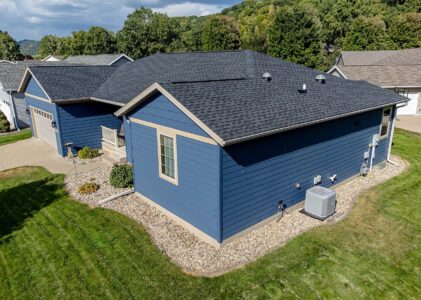
Siding replacement cost is one of the few exterior projects that can give back more than it takes. The 2025 Cost vs. Value report from Zonda and the Journal of Light Construction puts a national fiber-cement re-side at $21,485 and $24,420 of resale value — 114 percent recovered. Vinyl comes in at $17,950 and $17,313, or 97 percent. Those are the second- and sixth-best results among 28 tracked projects, ahead of a minor kitchen remodel. The catch is that the modeled job is a full re-side of 1,250 square feet, and the national number hides wide regional and access differences. Here is what the price actually buys, how vinyl and fiber cement compare, and when a partial repair makes more sense than a full replacement.
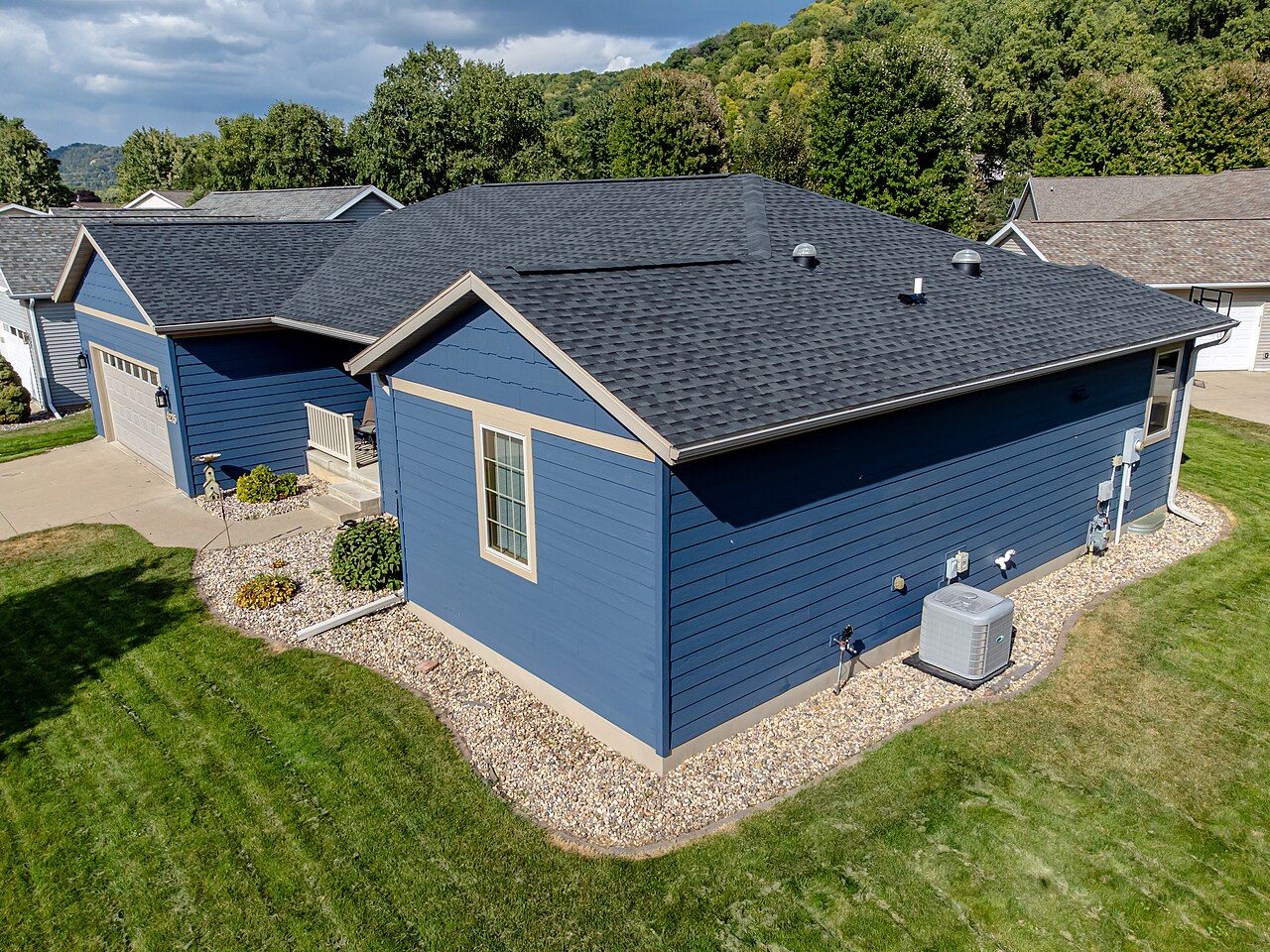
Siding Replacement Cost and ROI: The 2025 Benchmark
Zonda’s 2025 report prices 28 defined projects across 119 U.S. markets. For siding it models tearing off and replacing the existing cladding on 1,250 square feet of wall, with the new material installed to the manufacturer’s specification. The national averages are:
- Fiber cement: $21,485 job cost, $24,420 resale value, 114 percent recouped — rank 4 of 28.
- Vinyl: $17,950 job cost, $17,313 resale value, 97 percent recouped — rank 6 of 28.
Only five projects in the entire report beat 100 percent, and three of them are exterior: a garage door, a steel entry door, and manufactured stone veneer. Siding’s strong showing reflects something buyers understand intuitively — fresh cladding changes the whole appearance of a house and signals that the envelope has been maintained. It ranks well above a wood deck at 95 percent, vinyl windows at 76 percent, and an asphalt roof at 68 percent. Our ROI comparison shows where it sits against all 28 projects.
Regional performance varies sharply. In the Middle Atlantic in 2025, fiber cement recouped about 99 percent and vinyl about 96 percent; other markets run higher. A national percentage is a benchmark, not a quote for your zip code.
What Drives the Price
Installed pricing is usually quoted per square foot of wall, not floor area. Typical 2026 ranges are:
- Vinyl: roughly $4 to $9 per square foot installed, with builder-grade hollow-back panels sometimes as low as $2 to $6. Most full-home jobs land between $7,000 and $18,000.
- Fiber cement: roughly $6 to $13 per square foot installed, with some premium estimates running $10 to $18. A typical 1,800-square-foot wall area works out to about $18,000 to $32,000.
- Tear-off and disposal: removing old cladding, hauling it away, and repairing the sheathing underneath is a separate line item and the most common source of a change order.
- Trim and accessories: corners, J-channels, fascia, soffit, and window trim add material and labor; a house with many gables costs more than a plain rectangle.
- Access and complexity: two-story walls, steep sites, dormers, and tight side yards can add 15 to 35 percent through scaffolding and handling.
- Region: labor rates and code requirements vary enough that two identical houses in different states can differ by 20 percent or more.
Ask for an itemized bid that names the manufacturer and product line, the number of layers being removed, the house-wrap specification, how damaged sheathing is priced, and who handles permits. A low bid that omits tear-out is not a saving — it is an incomplete scope.
Vinyl or Fiber Cement?
Vinyl wins on price and on low maintenance. It never needs painting, it handles moisture well, and modern insulated panels improve energy performance. Its weaknesses are heat expansion, susceptibility to impact damage, and a reputation for looking less substantial than masonry. Fiber cement — cement, sand, and cellulose — is heavier, fire-resistant, holds paint far longer, and mimics wood more convincingly. It also scored 17 points higher on cost recovery in the 2025 report, $21,485 in at $24,420 out. The tradeoffs are a higher up-front price, specialized cutting tools, and a real dust hazard if installers cut it dry rather than with wet saws and proper respirators.
Wood siding and engineered wood sit between the two on appearance and cost, but need more maintenance. Manufactured stone veneer is a different category entirely: it sits at 208 percent recovery in the same report, but it is an accent applied to a portion of the wall, not a whole-house cladding. Our manufactured stone veneer cost guide explains where the two can be combined — stone at the entry, siding everywhere else. In wildfire-prone areas, fiber cement’s noncombustible classification may be required by code or insurance, which decides the question before resale math enters it.
Repair, Partial Replacement, or Full Re-Side?
A few cracked panels, a loose piece of trim, or a localized moisture problem can often be repaired for $200 to $1,500. Partial replacement makes sense when damage is confined to one wall — a sprinkler hitting the same elevation for years, for example. Full replacement becomes the right call when panels are fading uniformly, seams are opening across multiple walls, paint is failing repeatedly on fiber cement, or the wrap and sheathing underneath have been wet. A full re-side is also the moment to add insulation, upgrade house wrap, and flash windows properly; opening the wall later costs far more.
Because siding and roofing share the same exterior envelope and often the same contractor, coordinate the schedule. Our roof replacement cost guide covers the other big exterior line, and the curb appeal rankings show which smaller updates pair well with new cladding — a new door, updated house numbers, and clean landscaping all read differently against a fresh facade.
Timing and Contractor Checks
Schedule siding work in late spring through early fall. Installers need dry sheathing and a window for painting fiber cement, and winter jobs in cold climates risk poor sealant adhesion. Get at least three bids, verify licensing and insurance, and ask whether the crew is certified by the product manufacturer — for fiber cement, that certification often affects the warranty. Confirm in writing who repairs rot discovered after tear-off and at what per-square-foot rate. Check that the plan includes proper flashing at windows and doors, a rainscreen gap where required, and a house wrap that is lapped correctly; most siding failures are water problems hidden behind a perfectly good-looking surface. Permits are usually required for a full re-side, and a contractor who skips them can leave you with a problem at sale.
The Bottom Line
Budget roughly $7,000 to $18,000 for a full vinyl re-side and $18,000 to $32,000 for fiber cement on a typical home, with $4 to $9 and $6 to $13 per installed square foot respectively. The 2025 national model returns 97 percent on vinyl and 114 percent on fiber cement, so the more expensive material actually recovers a higher share and more dollars at sale. Choose vinyl for a tight budget and low maintenance; choose fiber cement for longevity, fire resistance, and resale. Either way, the money is in the prep and the details behind the panels — tear-off, sheathing repair, wrap, and flashing — not in the panels themselves.